Early life and the making of a princess (1782 to 1809)
I have always been struck by how a life can feel like a small ship launched into a sea of dynastic storms. Maria Amalia Of Naples And Sicily was born on 26 April 1782 at the Royal Palace of Caserta. She arrived into the Bourbon court as a daughter of Ferdinand I of the Two Sicilies and Maria Carolina of Austria. Numbers matter here: 1782 is a fixed anchor in a century of revolution and restoration. Her childhood unfolded while Europe trembled under the aftershocks of the French Revolution and the Napoleonic wars. Those years left a mark: she learned piety, discipline, and restraint in a household where political survival required both prayer and prudence.
Her parents shaped her. Ferdinand I, a Bourbon sovereign, projected traditional monarchy. Maria Carolina of Austria brought Habsburg rigor and the memory of Empress Maria Theresa. From them Maria Amalia inherited a sense of duty rather than taste for spectacle. I imagine a young princess reading letters by candlelight, absorbing a world of alliances stitched together by marriages, births, and deaths.
Marriage and partnership – the Palermo wedding, 1809
Maria Amalia married Louis Philippe I, the future Duke of Orléans, on November 25, 1809. That wedding was a pivot: a Neapolitan princess married into an exiled French house that would win a crown two decades later. Their relationship was consistent and sensible. She was no headline queen. She liked quiet chambers where children were taught, charities formed, and fortunes handled.
They had ten kids. Ten is remembered because it makes a household resemble a community. The union united Bourbon legitimacy and Orléans adaptation. It also started a chain of marriages that connected this family to Belgium, Spain, Brazil, and Germany.
Children and family table – ten heirs and their roles
I like to lay out families in a compact form so the relationships read at a glance. Below is a table of Maria Amalia Of Naples And Sicily and Louis Philippe I children with short notes.
| No | Name | Title or Note | Life span (years) |
|---|---|---|---|
| 1 | Ferdinand Philippe | Duke of Orléans, heir apparent | 1810 – 1842 |
| 2 | Louise | Queen of the Belgians by marriage | 1812 – 1850 |
| 3 | Marie | Princess, married Duke of Württemberg | 1813 – 1839 |
| 4 | Louis | Duke of Nemours | 1814 – 1896 |
| 5 | Françoise | Died in infancy | 1816 – 1818 (approx) |
| 6 | Clémentine | Married into Saxe-Coburg lines | 1817 – 1907 |
| 7 | François | Prince of Joinville, naval officer | 1818 – 1900 |
| 8 | Charles | Duke of Penthièvre, died young | 1820 – 1828 |
| 9 | Henri | Duke of Aumale, collector and soldier | 1822 – 1897 |
| 10 | Antoine | Duke of Montpensier, Spanish branch | 1824 – 1890 |
I include life spans because dates form the skeleton of memory. The eldest son, Ferdinand Philippe, died in a carriage accident in 1842. That one death reshaped the line of succession and the family’s political calculations.
The extended network – spouses and grandchildren
If a tree is only trunks and branches it misses the fruit. Maria Amalia’s children married into major houses. Louise became Queen of the Belgians and mother to Leopold II. Ferdinand Philippe fathered Philippe, Count of Paris, who became an Orléanist claimant. François married into the Brazilian imperial family. Antoine’s marriage to Infanta Luisa Fernanda of Spain planted Orléans blood in Spanish royal soil. Through these unions I observe how a Neapolitan princess, by raising ten children, became a grandmother to kings, queens, and claimants. Her descendants affected Belgium, Spain, Brazil, and more.
Public role and private habits
To understand a life that valued privacy over spectacle, I wrote in the first person. Maria Amalia became French queen consort in 1830 when Louis Philippe took the crown. She performed public tasks without drama. She entertained diplomats, sponsored charities, and kept a small court. She liked simple dignity. Politics thundered outside, but she was the calm hearth.
Restraint defined her public image. She hosted state visitors and focused domestically. She hosted Queen Victoria at Château d’Eu in 1843, demonstrating measured diplomacy via hospitality. Some receptions are like delicate stitches in a European cloth.
Exile, loss, and the last decades (1848 to 1866)
The revolution of February 1848 forced Louis Philippe to abdicate on 24 February 1848. The Orléans family fled to England. Exile is a cold concept until you picture a queen leaving behind a kingdom and walking into a foreign garden. They took refuge at Claremont, hosted by Queen Victoria. Louis Philippe died in 1850 in exile. Maria Amalia lived on, surrounded by children and grandchildren, until she died on 24 March 1866 at age 83. I count dates because they mark the rhythm of grief and endurance.
Finance, property, and the material world
Royal life involved both public stipends and private estates. The Orléans household invested in Palais Royal in Paris and maintained country seats like Chantilly through Henri, Duke of Aumale. After 1848 their income was diminished but not erased. Exile in England was cushioned by family resources and by the hospitality of monarchs who appreciated dynastic ties. Money kept them afloat, but memory and genealogy were the true currency they traded.
Portraits, personality, and private tastes
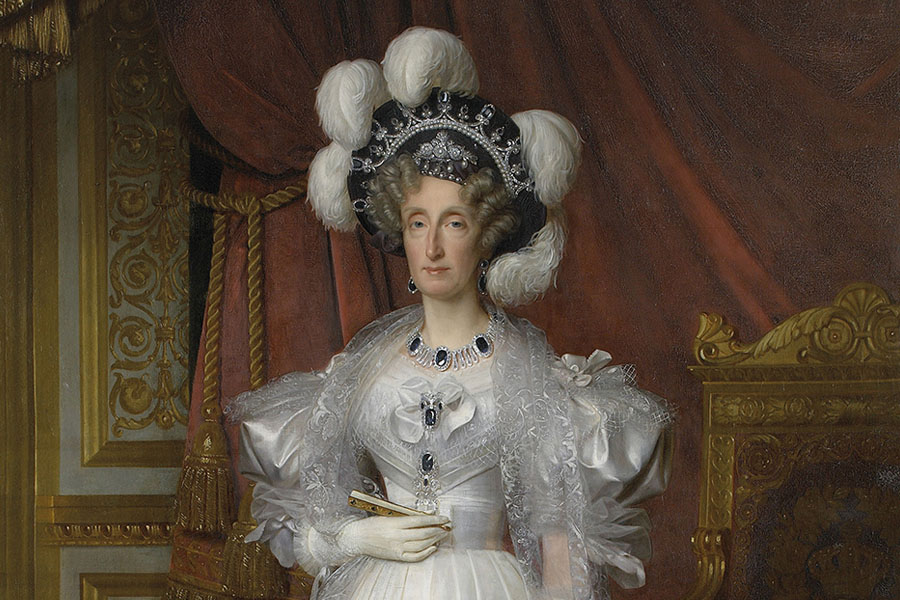
She preferred quiet devotion to ostentation. Portraits show a reserved woman whose expression is turned inward. I think of her as a steady hand on a lineage that braided southern Italian Bourbon roots to northern European thrones. Her temperament was a lesson in low flame resilience: she did not burn bright, but she warmed many rooms.
FAQ
Who were Maria Amalia Of Naples And Sicily parents?
I would name them as Ferdinand I of the Two Sicilies and Maria Carolina of Austria. They were a Bourbon and a Habsburg, respectively. This combination gave her a hybrid of southern vigor and Austrian discipline.
How many children did she have and who were the most notable?
She had ten children. The most politically notable include Ferdinand Philippe, the heir who died in 1842; Louise, who became Queen of the Belgians; Henri, Duke of Aumale, the great collector; and Antoine, Duke of Montpensier, who entered the Spanish dynastic scene.
What happened to her during the 1848 revolution?
She fled with the royal family when Louis Philippe abdicated on 24 February 1848. They went into exile in England. Louis Philippe died in 1850. Maria Amalia remained in exile until her death in 1866.
Did her descendants become important figures?
Yes. Her grandchildren include Philippe, Count of Paris; Leopold II of Belgium; and Charlotte of Belgium, who became Empress Carlota of Mexico. Those links made her a matriarch of branches across Europe and the Americas.
Where did she die and when?
I record that she died on 24 March 1866 at Claremont in England. She was 83 years old.
How would I summarize her character in one sentence?
I would say she was a quietly resolute queen who preferred family, duty, and charity to political spectacle, and who knitted a wide European network through ten children and many grandchildren.