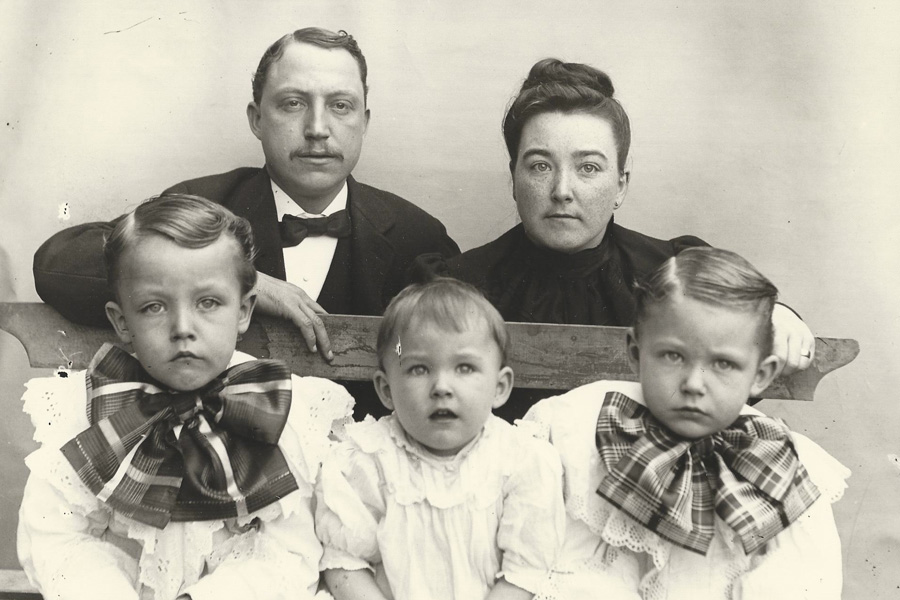
Early life and family roots
I started this account with the intention of standing near a life that started on November 12, 1858. William Archibald Carter was born into a network of farms and names in the rural South. Mary Ann Diligence Seals and Littleberry Walker Carter were his parents. Wiley Carter and Ann Ainsley are on one side of the family lines, while William Archibald Seals and Eliza Harris are on the other. These names sound like history itself. William is rooted in a world of fields, mills, and familial responsibilities in 19th-century Georgia thanks to those names.
I see the young William traveling among relatives and discovering how effort and land equated to food. In addition to his actions, he inherited his family’s discipline of using his hands and cunning to make things work.
Marriage and children
On 8 September 1885 William Archibald Carter married Nina Pratt. Their union produced several children across the 1880s and 1890s, among them Ethel, William Alton who later came to be known as Alton, Lula, and notably James Earl Carter Sr who was born on 12 September 1894. I see a household of five or six children, small voices and responsibilities, groceries and sewing, stores and chores.
The next generations would include names familiar to many: James Earl “Jimmy” Carter Jr born on 1 October 1924 would later make the family name known worldwide. But within the century that followed William Archibald Carter his grandchildren and great grandchildren included Gloria Carter Spann, Ruth Carter Stapleton, William Alton “Billy” Carter, and others such as Amy Carter and Sydney Scott Stapleton within the extended branches.
Work, businesses, and finances
Being a farmer alone did not satisfy William. I saw him as a hardworking man who managed farm land in the Rowena and Arlington region while operating two sawmills, a cotton gin, and a small vineyard. These are companies that need lumber, mechanical expertise, seasonal workers, and a readiness to take on risky mill and press investments.
Here, numbers are important. Having two sawmills means having several crews and sources of income. A consistent supply of cotton from nearby planters and an investment in machinery are necessary for a cotton gin. A winery in that area and the period implies variety and experimentation. When combined, these businesses depict a man who was not reliant on a particular market or crop.
I am unable to obtain precise monetary amounts from financial data at this time. All I can tell is that his working capital was made up of property and equipment. In addition to generating revenue, the companies exposed people to disagreements, bad weather, and human conflict. His estate was divided after his passing, and the family’s financial situation shifted. His widow Nina and the kids moved and adjusted to the new economic climate, with the sons going into trades and retail.
Life events and the turning point of 1903
I cannot tell the story of William Archibald Carter without stopping at early September 1903. On 3 or 4 September 1903 he was shot and killed in an altercation in the Rowena or Arlington area. The episode is sudden, raw, and decisive. A quarrel that escalated into violence ended his life at the age of 44.
That event is a hinge. It closed his enterprises and forced the family to make hard choices. Property was liquidated. Nina moved with her children back to Plains and the economic trajectory of the family shifted from one generation to the next. The sudden removal of a breadwinner in 1903 is a concrete number with heavy consequences.
Extended timeline
I like timelines because they compress complexity into readable ticks. Below is a compact table of the principal milestones I have followed.
| Date | Event |
|---|---|
| 12 Nov 1858 | Birth of William Archibald Carter |
| c. 1832 and c. 1838 | Births of his parents Littleberry Walker Carter and Mary Ann Diligence Seals – ancestral context |
| 8 Sep 1885 | Marriage to Nina Pratt |
| 1887 to 1894 | Births of children including Ethel, William Alton, Lula, and James Earl Carter Sr on 12 Sep 1894 |
| Late 1880s to 1903 | Operation of two sawmills, a cotton gin, a winery, and farm activities in Rowena/Arlington area |
| 3 or 4 Sep 1903 | William Archibald Carter was shot and killed; his death precipitated family relocation and property sale |
| 1 Oct 1924 | Birth of grandson James Earl “Jimmy” Carter Jr, later a national figure |
The family as a living web
I write in first person because family histories feel personal. I can trace how the loss of William shaped the choices his children made. One son moved into general stores, another into farming with different scale and risk, and successive descendants spread into civic life and national prominence. Names like Gloria, Ruth, and Billy echo through family memory. Great grandchildren carry the small legacies of earlier households: habits of work, a willingness to shift careers, and a readiness to step into public roles.
A family is like a river delta. Each tributary keeps the water but alters its course. The death of a patriarch diverts channels, but water still finds a way to reach the sea.
FAQ
Who were William Archibald Carter parents and grandparents?
His parents were Littleberry Walker Carter and Mary Ann Diligence Seals. Paternal names include Wiley Carter and Ann Ainsley. Maternal grandparents include William Archibald Seals and Eliza Harris. These names sketch a multi generational Southern family through the 19th century.
When did William Archibald Carter marry and who was his spouse?
He married Nina Pratt on 8 September 1885. Nina survived him and later relocated with their children after his death in 1903.
What were his main businesses and occupations?
He ran two sawmills, operated a cotton gin, maintained a small winery, and worked the family farm. These were distinct revenue streams and required machinery, seasonal labor, and trade relationships.
When and how did he die?
He was shot and killed on 3 or 4 September 1903 in an altercation in the Rowena or Arlington area. The event was abrupt and it forced a rapid reorganization of family finances and residence.
Who are notable descendants of William Archibald Carter?
Notable descendants include his son James Earl Carter Sr and grandson James Earl “Jimmy” Carter Jr born 1 October 1924. Other descendants who carried the family name into public view include Gloria Carter Spann, Ruth Carter Stapleton, William Alton “Billy” Carter, and later generations such as Amy Carter.
How did his death affect the family financially?
After his death property and businesses were sold or otherwise dispersed. The widow Nina moved back to Plains with the children. Sons took up trades and retail work; the family shifted from diversified rural enterprise to a mix of retail, farming, and other livelihoods.
Are there dates to anchor this story?
Yes. Key dates are 12 November 1858 for his birth, 8 September 1885 for his marriage, 12 September 1894 for the birth of his son James Earl Carter Sr, and 3 or 4 September 1903 for his death. These numbers form the spine of the narrative.
What does his life tell us about the era he lived in?
His life reflects the late 19th century rural South: entrepreneurial risk, reliance on diverse small industries, and vulnerability to sudden loss. It also shows how family resilience, migration, and adaptation shaped the next generation.